Editor’s note: This is the first of a five-part series chronicling the history of the Western Collegiate Hockey Association, now in its 25th season as the best conference in women’s ice hockey.
Part One: The early years
By Bill Brophy
WCHA CELEBRATION 25 PHOTO GALLERY
Many years before he became the winningest head coach in women’s college hockey, Mark Johnson recalls his introduction into the competitive spirit of the Western Collegiate Hockey Association.
It was a Saturday morning, Oct. 9 of 1999 to be exact. Wisconsin had played its first-ever women’s game the night before and was trounced by Minnesota Duluth 8-1 in the first-ever WCHA game in Wisconsin. Johnson was an assistant coach to Badgers’ men coach Jeff Sauer that morning and was sitting in the corner of the rink watching an intrasquad scrimmage as the Badgers prepared for their first-ever men’s game in the Kohl Center the next week. Sauer noticed a ruckus in the far corner of the rink, where UMD players dressed and came out on to the ice. UMD’s coach Shannon Miller was adamant that her team’s pre-game skate before the WCHA series finale was going to start on time.
“I remember it like yesterday, “ said Johnson from his current office at the home of Badger women’s hockey, LaBahn Arena. “I was sitting next to Jeff, who was instrumental in getting hockey started at Wisconsin, so he knew all the women’s coaches. He taps me on the shoulder and says go tell Shannon it’s going to be five minutes and we will be off.
“So I go down to the far corner and I said “Coach Sauer said we will be done in five minutes. A couple more power play rushes and we will be done.’ She says ‘nope, we are going on at 11.’ I said “OK.’ And now it’s 11 o’clock. I will never forget, we have our penalty killers out there and there is a line rush coming south to north and the door opens and all of a sudden, “Here comes the Bulldogs.”
And here came the start of a rivalry. Here came competitive and talent coaches, world-class players, feistiness and a spirit that women’s college hockey wasn’t going to take a backseat to anyone.
Miller’s Bulldogs beat the Badgers 4-2 that night in front of 1,076 fans and went on to win the WCHA playoff championship that season and finished third in the country. The series attracted 4,968 people in Madison, Wisconsin’s introduction to women’s college hockey.
The WCHA consisted of seven teams in its first season, 1999-2000. There were three Big Ten schools – Ohio State, Minnesota and Wisconsin – plus Minnesota schools with a tradition in men’s hockey – Bemidji State, St. Cloud State, Minnesota Duluth and Minnesota State.
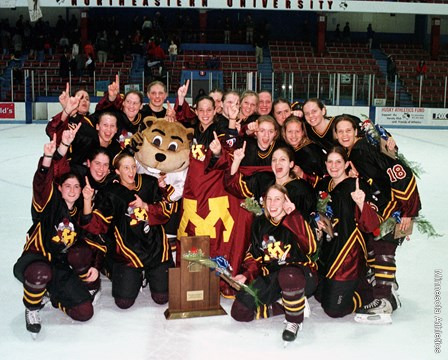 2000 national champs from Minnesota
It didn’t take long for the WCHA’s Magnificent Seven to become the powers of women’s ice hockey even if the schools from the Eastern Collegiate Athletic Conference had a head start in establishing the sport.
In its first 24 years, the WCHA has won an unprecedented 20 national championships while finishing as the national runner-up nine times since 1999. Since the inception of the NCAA women’s ice hockey championship in 2001, the WCHA has won 19 titles, including the last four (Wisconsin has won seven titles, Minnesota has won six, UMD five and Ohio State one national championship). The WCHA has had at least one team in every Frozen Four and qualified two or more teams in 17 Frozen Fours.
The league has produced nine Patty Kazmaier Memorial Award winners, which goes to the best women’s collegiate player annually, and had 24 student-athletes who were among the top-3 finalists for the award. In addition, WCHA student-athletes have been recognized as All-Americans 121 times in league history.
“The proof is in the pudding about the quality and success of our league as a whole,” said Maura Crowell, the current Minnesota Duluth head coach who came to the WCHA after working in the ECAC at Harvard. “It’s not just the teams that have won the big trophy. It’s the teams that we play against night in and night out that make us as successful as we are as a league.
“As a result we attract the best players from around the world – European players and beyond. Canadian, U.S. players. The top players want to play in this league because they want to be challenged – by their own teammates and every weekend it’s going to be a dogfight. It doesn’t matter what the records are. There are no guarantees in this league. That’s what makes it so special.”
Brad Frost has been in the WCHA for 23 years, first as an assistant coach and then the last 17 as head coach at Minnesota.
“I love the professionalism of the league,” said Frost who has won four national titles. “Our players and players from around the WCHA are treated like NHLers. They have full-time equipment staff. They have the full-time coaching staffs. They have the athletic trainers. They have all the people to help make this experience one they are going to remember for the rest of their lives. The best players play in the WCHA for the most part. We have seen this in the number of championships the WCHA has won.
“In my opinion, the WCHA has always been in the front line. How can we continue to get better, from an on-ice and off-ice perspective? The schools have invested in these programs and it has been fun to grow over the last 25 years. It has been awesome to be a part of.”
So how did we get here, from the days when people were worrying about Y2K and playing GameBoy to today when they worry about Taylor Swift’s future with Travis Kelce and AI?
When the WCHA was born, it is best to realize what the landscape of girls and women’s hockey looked like.
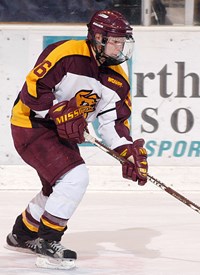 UMD's Jenny Schmidgall-Potter
The first known girls' youth hockey program in Minnesota was established by the Lake Region Hockey Association with the first game is played in Arden Hills, Minn. on January 10, 1971. USA Hockey, the governing body of hockey in this country, was known as The Amateur Hockey Association of the United States in 1980 and hosted the first national championships for girls' pee wee and midget divisions. A team from Taylor, Michigan won the inaugural pee wee tournament and a team from Wayzata, Minn., was the first girls' midget national champion.
In 1984, Providence College won the inaugural ECAC Women's Championship. Years later, legendary USA Olympian Cammi Granato went to school at Providence and Laura Halldorson coached and played at Princeton.
In 1997–98, the American Women's College Hockey Alliance debuted. It was a program funded through the United State Olympic Committee with help from the NCAA Conference Grant Program. The AWCHA organized and developed activities with collegiate women's varsity teams and helped to promote women's ice hockey at all NCAA levels and the first AWCHA National Championship was held in March 1998. New Hampshire defeated Brown 4–1 to become the first recognized national champion.
That summer Chris Voelz, the women’s athletic director at Minnesota and an acclaimed advocate for women’s sports, recognized the growth of ice hockey in Minnesota and saw what an impact the United States’ gold medal victory over Canada in the 1998 Olympics had on the popularity of women’s sports in general. Halldorson, who had been head coach of an independent team at Minnesota since 1997, said Voelz was the impetus for the league’s founding.
She formed a group along with Michigan’s senior women’s administrator Peggy Bradley to discuss the options for a women’s intercollegiate hockey league with Western schools. Voelz’s group considered three options and they sought funding from the USOC to help start the league: Her group, which was made up of the seven eventual WCHA schools, plus Michigan and North Dakota, could play independently or in a hybrid model, playing against Eastern teams as well as among themselves, or they could contact WCHA commissioner Bruce McLeod about the viability of playing as the women’s league under the WCHA umbrella.
“Chris wanted women’s hockey to be featured, not as afterthought,” said Halldorson, a Minnesota native who played at Princeton and coached at Colby before getting behind the Gophers bench.
In 1998, the WCHA had ten member institutions playing men’s hockey. Half of them -- Denver, Michigan Tech, Colorado College, Alaska Anchorage and North Dakota – were not considering women’s hockey or, maybe more importantly, funding the start-up of women’s WCHA.
“Chris later told me there was a little bit of distrust and skepticism,” said Halldorson. “Bruce had to make sure in setting things up, there was a way that women who were advocates for hockey, had to satisfied.”
McLeod, said he had many conversations with Voelz about a women’s league. “Chris had the original idea for a women’s league and promoted it. She was the impetus behind it and she brought schools to Minnesota to talk to us about her idea for a league for women. We kind of worked together to talk about schedules, operation manuals, a lot of things people don’t think about when you start up a league.”
McLeod said he still doesn’t know why Michigan dropped out its plans to join the fledging women’s league and never has established an intercollegiate women’s programs. But St. Cloud, Bemidji, Mankato and Duluth officials were convinced to upgrade their club and independent teams and start inter-collegiate programs. They were hopeful to join Minnesota, which started women’s hockey in 1997, Ohio State and Wisconsin in beginning the new league. And Voelz became convinced that joining the WCHA was the best option for her idea to come to fruition.
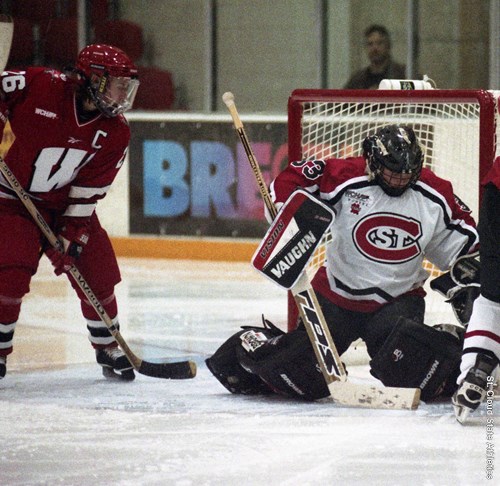 UW at SCSU in the first year of WCHA play.
“There were some schools that still wanted it to be an independent group,” said McLeod, now retired and living in Denver. “When you start new, things are a lot different than piggybacking on an existing league.
“I talked about the attributes of the WCHA, the support we could bring and an administration that had experience in college hockey and knew about the philosophy of women’s programs. Then there was the reality of cost to set up a separate operation. There is a process that takes time.”
To give context, the WCHA’s men league was a national power and being dominated by North Dakota and Wisconsin in the 90’s. The league’s playoff championships were drawing near sellout crowds to the Civic Center in St. Paul and when St. Paul’s rink wasn’t available, the WCHA attracted 38,707 for the three-day event in Milwaukee in 1998. Some schools didn’t want changes to affect the golden goose, even though the WCHA changed radically in 2013 when the landscape of men’s college hockey was altered.
“I also had to go back to people in the men’s league. Some didn’t want any part of women’s league.,” McLeod recalled about the negotiations. “There was some leeriness on the part of the men’s league too. It wasn’t an easy thing to get done.”
McLeod credits former Bemidji State athletic director Bob Peters, whose team didn’t join the men’s WCHA until 2010, for endorsing the women’s conference. “Bob was the most aggressive to get both men and women into the WCHA. He thought the prestige of the men’s league would give the new league instant credibility.”
McLeod felt a breakthrough came in January, 1999 in San Antonio, Tex. “Chris, Peggy and I met at the NCAA convention and did a lot of the footwork.”
Voelz and McLeod decided the new league would have its own commissioner and McLeod met one time to brief the men’s league’s administrators.
“We had to set up the administration and officiating program and talk about a schedule for each school,” said McLeod “A lot sensibilities to work through. Finally we agreed to piggyback the women with the men and talked about the finances. It took awhile and we got there.”
On April 29, 1999, the WCHA officially founded the women’s league after a vote at its annual meetings in Marco Island, Fla. Darryl Smith, the chair of the WCHA executive committee and the faculty representative from Michigan Tech, made the announcement that seven teams would play a 24-game schedule league schedule followed by a league tournament.
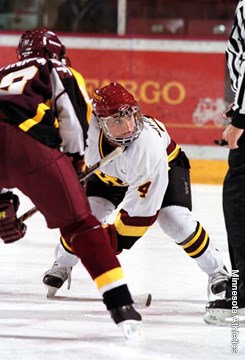 Minnesota's Nadine Muzerall
Sara Martin, who had worked at the University of Wisconsin, was named an associate commissioner for the WCHA and was the chief administrator for the new league. It was a role Martin served for 15 years. The coaches the first season were Halldorson at Minnesota, Miller, a former police officer who coached Canada to a silver medal in the 1998 Olympics, at Minnesota Duluth, Julie Sasner, who had coached Cornell for six years, at Wisconsin, Jackie Barto, a former coach at Providence, at Ohio State, Ruthann Cantile at Bemidji State, Kerry Brodt-Wethington at St. Cloud State and Todd Carroll at Minnesota State.
“One of our first challenges, I think, was getting all the schools to all be in a Division 1 mentality,” said Martin, the longest tenured of the league’s five commissioners in the first 25 years. “We had guidelines from the beginning and what each school needed to do to compete as a Division 1 program. A couple schools took longer to get there than others. But each school needed three coaches, a rink that was acceptable, full scholarships. For some schools that was phased in over first few years. Getting everyone up to be fully D1 members was one thing. In competition some started stronger than others. And we needed to get the league to close to having parity. We went through a phase where we didn’t have that.”
Halldorson thought the league infrastructure and setting guidelines was one of the reasons for the early success.
“Teams out here, particularly Division 1 schools, had resources, great interest in hockey and, as soon as we got going with the support we had, you had a feeling that we were going to get better quickly. We did,” said Halldorson. “It surprised a lot of the ECAC schools. Our commitment to women’s hockey made a big difference and the ability to recruit high end players off the bat. We had nice facilities because of the league’s history with men and we had an infrastracture that enabled us to move strongly and quickly.”
One of Martin’s first jobs was to name Greg Shepherd as supervisor of officials, a post he held for McLeod on the men’s side and a position Shepherd has held for all 25 seasons of the women’s WCHA. Martin also established the WCHA Playoff Championship tournament, which moved to five different arenas in the first five years of the new league In March, 2000, all seven teams reached the three-day event, which was held at Bloomington Ice Garden and attracted 6,407 fans. Regular season champion Minnesota Duluth received a first-round bye and eventually reached the title game against downstate rival Minnesota. UMD won 2-0 but both teams advanced to the national tournament, sponsored then by the AWCHA. They staged a rematch March 24, 2000 in Boston and the Gophers prevailed in a 3-2 semifinal thriller. The next day Minnesota beat Brown to win the national championship.
Halldorson won 278 games in her 10 seasons as Gophers’ coach. That comeback win against UMD stands out. “We had to rally and Muzzy (current Ohio State coach Nadine Muzerall) had a big goal. When we beat Brown it was almost anti climatic.”
The Gophers and Bulldogs always had a hockey rivalry when Doug Woog and Mike Sertich were coaching on the men’s side. Now Halldorson vs. Miller was a main event too. Either one or the other coached their teams to the regular season title in each of the league’s first six years. Miller won five national titles and Halldorson three in their careers.
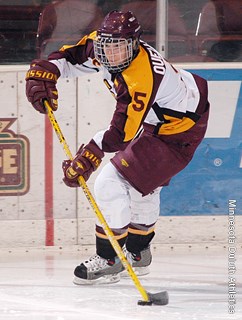 UMD's Caroline Ouellette
In the early years of the league, both teams had stars as well. The Gophers had Muzerall, Winny Brodt, Courtney Kennedy, Ronda Curtin and U.S. Hockey of Famers Krissy Wendell and Natalie Darwitz and are still remembered as some of the best players in WCHA history. The same can be said for UMD’s Jenny Schmidgall-Potter, Maria Rooth and Caroline Ouellette, who will be inducted into the Hockey Hall of Fame in Toronto later this year.
“We had a wonderful rivalry,” Halldorson says. It was intense on the ice and some storylines off the ice. Looking back now, for our sport and our league, it added not only interest to public, but media was interested in that. I think it was good for our league.
“We had very different programs. We had primarily Minnesotans and Muzzy was our only Canadian. Shannon was coming off coaching the Canadian Olympic team and had international connections, so she had connections in Sweden. It was fun and a great rivalry. Then Wisconsin came along and that rivalry became big too. I think league the benefited from those rivalries.”
As it turned out, the Gophers won the last AWCHA title. In August 2000, the NCAA announced it would hold its first Division I Women's Ice Hockey National Championship. Minnesota Duluth captured the first NCAA Division I Women's Ice Hockey Championship, defeating St. Lawrence 4–2.
And the string of national championships had begun. It would not end until 2014.
Editor’s note: Bill Brophy is the former sports editor of the Wisconsin State journal who has covered the men’s and women’s WCHA since 1975. He has done radio and television for Wisconsin’s men’s hockey since 1990 through last season and has worked for the women’s WCHA as a public relations consultant since 2006.
Part 2 of the series: Wisconsin emerges as a national power and the WCHA expands to North Dakota