Editor’s note: This is the second of a five-part series chronicling the history of the Western Collegiate Hockey Association, now in its 25th season as the best conference in women’s ice hockey.
Part Two: Expanding to North Dakota and the Rise of Wisconsin
By Bill Brophy
WCHA 25th Anniversary Photo Gallery
The early years of the Western Collegiate Hockey Association were dominated by Minnesota and Minnesota Duluth with its superstars like the Gophers’ Natalie Darwitz, Krissy Wendell, Courtney Kennedy and Ronda Curtin and the Bulldogs’ Maria Rooth, Jenny Potter, Erika Holst and Caroline Ouelette. In fact, Ouellette, in her induction speech to the Hockey Hall of Fame, called her days at UMD “the defining moment in my career.”
Wendell became the first of the WCHA’s nine Patty Kazmaier Award winners as the best women’s collegiate hockey player in 2005 when she led Minnesota to the national championship. It was the Gophers’ second straight title and the fifth in a string of 13 NCAA titles for the WCHA in its’ formative years.
“Early on it was all Minnesota and UMD,” said Mark Johnson, Wisconsin’s coach who started coaching women’s hockey in 2002. “When I started, Minnesota and Minnesota Duluth had great runs with great teams and we started to join the party.
“The most important thing was to get a balance, teams that were starting programs and building programs and get them to point where they could compete. A weekend series between X and Y early on, you could say that one team was going to sweep. Now we are at point where teams are deeper and well-coached. Games are competitive. Games are fun.”
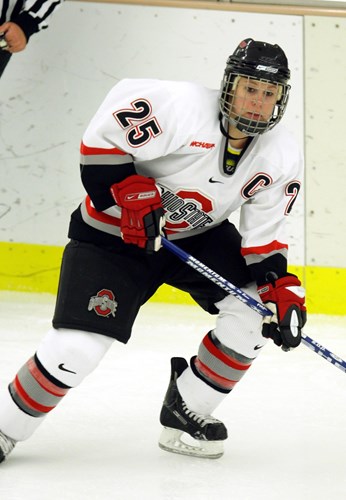 Tessa Bonhomme
As teams developed new stars like Tessa Bonhomme at Ohio State and Sara Bauer and Jessie Vetter at Wisconsin and Kim Martin at UMD, player rosters became deeper.
There were more opportunities for players. The league expanded to eight teams when North Dakota joined the league for the 2004-05 season. North Dakota was initially considered as a league member but didn’t join. The school played an independent schedule in 2002-03 and 2003-04 under coach Shantel Rivard and officially joined the conference for the 2004-05 season.
“It was a no-brainer to add them,” said Sara Martin, the WCHA’s first commissioner. “They had a great hockey tradition on the men’s side and the men were a league member so it was a natural fit. The people love hockey in North Dakota and they had a great new building (the 11,643-seat Ralph Englestad Arena which opened in 2001). They were excited to join and getting an eighth team in the league was good for scheduling.
“We got the commitment from them that they would bring in resources to compete. The WCHA was all in for bringing them on board.”
The Fighting Sioux struggled in their first years, winning six conference games and finishing in seventh place in their initial season and then posting back-to-back three-win seasons. The lack of success caused the school to hire Brian Idalski in the summer of 2007 and Idalski changed the fortunes of the program and eventually added another nationally-ranked program to the league.
“From the beginning of the first season to the end, you could see the improvement in teams,” said Martin. “Players and teams were getting better. First, it was Duluth, then Minnesota, then Wisconsin and North Dakota. Maybe there still is not complete parity in the league, but it has gotten better.
“I think the schools we had really cared about women’s hockey and put resources in. They went and got good coaches – not that Eastern schools don’t – but from the beginning we had schools that were competitive and wanted to win. We had the men’s (WCHA) league as our model, because at that time they were most successful league. A lot of things they did, we did. Even if took us awhile to put in things two years later. Things like video replay were all ideas the men’s league did first. But all of schools were committed to making the women’s league a success.”
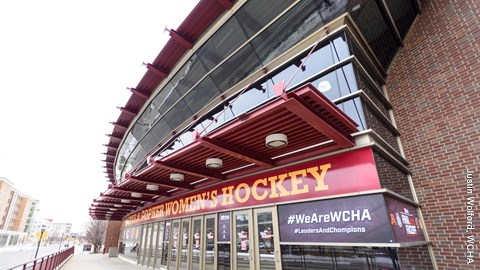 The University of Minnesota's Ridder Arena
Equally as important to the growth of the league was the opening of Ridder Arena on the campus of the University of Minnesota in 2002. Located adjacent to Mariucci Arena, it was the first facility in the United States built specifically for college women's ice hockey and seats 3,400, which includes club seating and luxury boxes. It gave Gophers’ women’s hockey a new home and was a boost to the WCHA.
“The building of Ridder was huge for our league,” said Martin. “It gave us a first-class facility for women’s hockey And a place to host our tournament.”
Ridder has been the host for the NCAA’s Women’s Frozen Four on four occasions and will host the national championship again in March, 2025. It has been the venue for the WCHA Playoff Championships all but four years since 2004 and will be the site of the WCHA 25
th anniversary celebration at the Final Faceoff in March.
St. Paul businessman Robert Ridder co-chaired a task force to build a rink for the women's team, but he died in 2000 before the completion of the project. Funding for the new arena was approved in 1999, and included contributions from the state of Minnesota, university fundraising, and other private donations. Ridder and his wife, Kathleen, donated $500,000 towards the project. The playing surface is National Hockey League size, measuring 85 feet wide, by 200 feet long, and smaller than 3M Arena at Mariucci. It is connected by a tunnel to allow sharing of a Zamboni with Gopher’s men program at Mariucci. The facility includes, a locker room specific to the women’s team, coaches' offices, referees' rooms, and public change rooms plus a 5,000-square-foot strength training area specific for the women's team.
Gophers’ coach Laura Halldorson felt that having a smaller arena created a better atmosphere for home games, instead of playing in the much larger Mariucci arena if the Gophers attracted the same size crowd. Halldorson’s successor, Brad Frost, certainly feels the same way. In the 16 years that the women's team has played at Ridder Arena, the team has won or shared 10 conference titles, and six national titles. The Golden Gophers won the NCAA Women's Frozen Four at home in 2013, when they completed an unbeaten season, and in 2015.
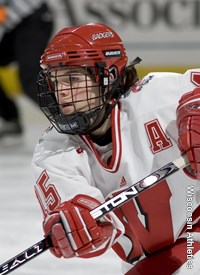 Sara Bauer
It has been the site of great moments. Like, for instance, the 2005 WCHA playoff championship, the final home appearances for future U.S. Hockey Hall of Famers Darwitz and Wendell at Minnesota, and future Patty Kaz winner Bauer at Wisconsin along with Molly Engstrom and Carla MacLeod. Wisconsin. The Gophers, the defending national champion, had a 1-0 lead after two periods of the tight-checking game when Bobbi Ross increased Minnesota’s lead with a power play goal five and a half minutes into the third period and the Gophers looked on their way to a second straight WCHA playoff championship. Coach Johnson pulled his goalie for an extra attacker with 1:12 left in regulation and MacLeod scored with 50 seconds left. With the crowd on its’ feet and the Badger goal still empty, MacLeod scored 26 seconds later and the Border Battle was, amazingly, tied with 24 seconds left in regulation.
But the game took an even stranger turn when Wisconsin took a penalty with 14 seconds left in regulation and the Badgers were assessed another minor at the end of regulation. It only took Wendell 19 seconds into overtime to score the game-winning 5-on-3 goal. Two weeks later Wendell won the Patty Kaz Award and the Gophers beat Harvard 4-3 to win the national championship in Durham, N.H.
Wisconsin ended the Gophers and UMD’s stranglehold on league and national championships the next year and Bauer was honored as the best player in college hockey in 2006. Three weeks later the Badgers beat Boston College to win the NCAA men’s title.
The Badgers’ victory signaled a changing of the guard in the WCHA in 2006. St. Cloud State, under coach Jason Lesteberg, finished in fourth place and, for the second straight year, the WCHA had three NCAA qualifiers in the national tournament, not just UMD and Minnesota. The league had developed into a powerhouse in the sport.
“People gravitate to winning programs,” said Johnson. “Early on, when Minnesota and Duluth were winning NCAA championships and then Wisconsin players want to play where the best players are playing. Ohio State and St. Cloud came along. We had good coaches. People were willing to work hard and recruit players.”
Frost, an assistant at Minnesota, succeeded Halldorson as the leader of the Gophers’ perennially successful program in 2007 in a season when Wisconsin beat UMD for the national championship in Lake Placid, N.Y., a hockey venue which had good memory for Johnson, the 1980 Olympic hero turned Badgers’ coach. Bauer was the league’s player of the year.
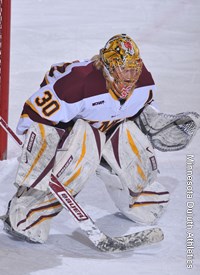 Kim Martin Hasson
The 2007-08 season was a strange one. Minnesota Duluth dominated the league standings for most of the year but the school was found to have used an ineligible player and the league title was vacated because of the violation. Nonetheless, the Bulldogs went on to the win the WCHA playoff championship and the national title on its home ice at the Duluth Entertainment and Convention Center. A sellout crowd saw Coach Shannon Miller win her fourth of five national championships and the Bulldogs blanked Wisconsin 4-0 behind the work of goaltender Kim Martin, who was a finalist for the Patty Kazmaier Award. Ohio’s Bonhomme was the player of the year.
Wisconsin won its third title in four years in 2009. The Badgers’ Hilary Knight was the league’s player of the year and her teammate Jessie Vetter was the second goaltender to win the Patty Kazmaier Award winner. Vetter had the shutout in the title game a day after accepting the Patty Kaz in Boston and the Badgers beat Mercyhust 5-0 at Agannis Arena to win the title.
It was the ninth straight NCAA title for the WCHA and it was clear: In women’s ice hockey, West was best.
Editor’s note: Bill Brophy is the former sports editor of the Wisconsin State journal who has covered the men’s and women’s WCHA since 1975. He has done radio and television for Wisconsin’s men’s hockey since 1990 through last season and has worked for the women’s WCHA as a public relations consultant since 2006.