(
Editor’s note: This is the fourth of a five-part series chronicling the history of the Western Collegiate Hockey Association, now in its 25th season as the best conference in women’s ice hockey. Part Four: Changes at the top and change in the league)
By Bill Brophy
There were many constants in the first 14 years of the Western Collegiate Hockey Association – a string of national championships and leadership from the same management team, which used the experience of a successful men’s league to give the women’s league a solid foundation.
But things changed in college hockey in 2014. On the ice, Clarkson snapped the WCHA’s stranglehold on the National Collegiate Athletic Association championship with a 5-4 victory over Minnesota in the national title game in Hamden, Conn. Clarkson, the only non-WCHA to ever win an NCAA title, also won national crowns in 2017 and 2018, which is the only season that the WCHA didn’t have a team in the championship game.
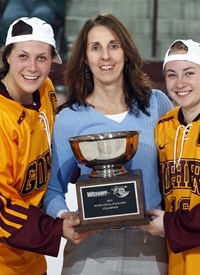 Sarah Martin (center)
Off the ice, the WCHA saw a change in leadership at the top. Sara Martin was the league commissioner for the first 15 years of the women’s league and provided stability. Martin resigned after the 2014 season and the women’s WCHA saw three commissioners in the next three years. The instability on the women’s side of the league was not as pronounced at the seismic shift in men’s college hockey during that period.
All during the formative years of the women’s WCHA, the men’s league flourished. It won seven national championships from 1999-2014 and, under the leadership of commissioner Bruce McLeod, regularly turned its league playoff championships into a college hockey festival at the Xcel Center in St. Paul, Minn. from 2001-2013, often playing before sellout crowds.
But the landscape of men’s hockey changed in 2011. The Big Ten announced the formation of its own hockey conference with WCHA cornerstones Minnesota and Wisconsin while the National Collegiate Hockey Conference was founded with six members of the men’s WCHA. Both the Big Ten and NCHC began play in 2013-14.
McLeod kept the men’s WCHA together by retaining Bemidji State, Minnesota State, Alaska-Anchorage Michigan Tech from the WCHA and recruiting six teams from the Central Collegiate Hockey Association, which folded after the shuffling of teams. McLeod, who based the men’s WCHA out of Denver, oversaw the new-look WCHA for one season and retired after 20 years as commissioner in 2014. He was succeeded by Bill Robertson, who had a long and successful career in public relations with baseball’s Anaheim Angels and the National Hockey League’s Mighty Ducks of Anaheim and the Minnesota Wild.
Just two weeks later -- after Robertson was named commissioner and announced the league office would move to Edina, Minn. -- the WCHA had a new women’s commissioner as well.
Aaron Kemp, a former player at Canisius and a senior associate athletic director at Mercyhurst, was named the women’s boss and the league office would move from Madison, Wis. to the Twin Cities. In taking the job, Kemp noted there would be some challenges in that the league only had two schools that had programs in both the men’s and women’s WCHA – Bemidji and Minnesota State. Meanwhile, Wisconsin, Minnesota, North Dakota, Ohio State, St. Cloud State and Minnesota Duluth would compete only in the women’s WCHA.
“I think it is important to have a commissioner on the women’s side,” Kemp said at his introductory press conference. “A big role is going to be finding revenue sources and improving attendance for our championship series.”
But while things were sometimes tumultuous off the ice, the product on the ice remained elite in the WCHA.
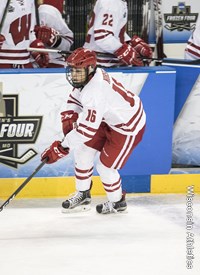 Sarah Nurse
Minnesota, with many players from its unbeaten team in 2013, won-back-to back national championships in 2015 and 2016. The Gophers did it unconventionally in 2015. After winning the WCHA regular season title behind all-Americans Hannah Brandt and Rachel Ramsey, Minnesota was stunned by Bemidji State and goaltender Brittni Mowat 1-0 in the semifinals of the Final Faceoff in Grand Forks, N.D. Wisconsin ruined the hopes of the hometown team by beating North Dakota 4-1 in the other semifinal and then the Badgers blanked Bemidji 4-0 behind the shutout goaltending of Ann-Renee Desbiens and two goals by Sarah Nurse.
Both Wisconsin and Minnesota qualified for the NCAA tournament and the Gophers took advantage of its past tournament experience, advancing to the championship game at Ridder Arena in Minneapolis and beating Harvard 4-1 for its third national crown in four years.
The Gophers’ domination continued in 2016 when a Brad Frost-coached team, led by future Olympians Brandt, Dani Cameranesi and Lee Stecklein, went to Durham, NH and beat Boston College 3-1 in the NCAA title game. Again, the Gophers did it in an unorthodox way as they saw Wisconsin win the regular season title and the Final Faceoff. Desbiens, another future Olympian, put on a goaltending show, blanking Minnesota Duluth 5-0 in the semifinals at Ridder and whitewashing the Gophers 1-0 in the playoff championship. But the Gophers got the last laugh, going out East the next weekend and winning its fourth NCAA title in five years and showing the women’s college hockey world, the WCHA was still best league. It was Minnesota’s sixth NCAA crown in school history.
Midway through the 2015-16 season, Kemp, who now is the business manager at Rensselaer Polytechnic Institute, resigned as the league commissioner and Robertson was named to oversee both leagues.
In July of 2016, the WCHA named Katie Million, the director of events for the New York State Olympic Regional Development Authority in Lake Placid, N.Y., as its third commissioner. Million had helped the Eastern Collegiate Athletic Conference host its tournament in Lake Placid so she was familiar with the college game. When at the national coaches convention in Naples, Fla. that year, Million learned more about the job and “decided to go for it. The more I learned about the WCHA, the more I felt it matched with my background in Lake Placid where I had worked for 17 years. I looked forward to the new challenge.”
Million brought marketing ideas to the league and, while overseeing the successful Final Faceoff championships started by Martin and Kemp, she also increased the league’s exposure. Under Million’s guidance, the WCHA delivered its first-ever extended women’s hockey television package via a partnership with FOX Sports North and FOX Sports Wisconsin, partnered with the Beaver Radio Network for the “This Week in the Women’s WCHA” radio show and St. Cloud State’s Husky Productions team for the “WCHA Highlight Reel.”
“I tried to promote league like it had been, but tried to do more with social media, fundraising and development,” said Million.
But the best marketing for the leagues has always been the product on the ice. That didn’t change when the commissioner’s office changed.
In 2016-17, three teams made the NCAA tournament – WCHA regular season and Final Faceoff champion Wisconsin, Minnesota and Minnesota Duluth. Desbiens won the Patty Kazmaier Award, the first WCHA player to win college hockey’s biggest individual honor since Minnesota’s Amanda Kessel in 2013 and Wisconsin’s Brianna Decker in 2012. The WCHA had four of the six players on the all-America team – Desbiens, Minnesota’s Stecklein and Kelly Pannek and UMD’s Lara Stalder, the WCHA player of the year. But Clarkson snapped the WCHA string of national championships again, beating Wisconsin 3-0 in St. Charles, Mo in the title game.
The disappointment of that loss was nothing compared to what occurred less than two weeks later.
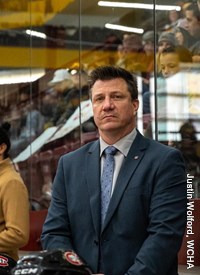 Brian Idalski
On March 29, 2017, the University of North Dakota announced it was cutting women's hockey – along with men's and women's swimming and diving – to meet a mandated $1.3M reduction in the athletics department budget that was part of a university-wide budget cut.
.
Brian Idalski had successfully used the tradition of North Dakota hockey to build a gritty team team that qualified to play in the NCAA tournament and produced world class players like hometown heroes Monique and Jocelyne Lamoureux and international stars like Michele Karvinen. The future looked bright as Idalski had recruited players like Ashton Bell and Kristin Campbell. Unfortunately, they never got a chance to play in Grand Forks.
The WCHA and college hockey world was stunned at the news. Million got the news from Idalski who had sensed something was going on, but never knew for certain.
“I had been in close communication with Brian Idalski and he thought something fishy was going on, if you will,” said Million. “But he was as surprised as all of us when the word came down. Clearly, losing North Dakota from the league was the biggest disappointment in all my years. It was shock to everyone. You don’t expect a program like that, with rich hockey tradition, to drop its program.”
Following the decision to drop the program, 11 ex-UND players filed a complaint claiming that dropping the program violated
Title IX guidelines. The U.S. Department of Education's Office for Civil Rights dismissed two discrimination complaints related to the decision and on June 20, 2019, a U.S. District Court judge dismissed a lawsuit against the school brought on similar grounds.
The loss of North Dakota meant the league had to operate as a seven-team league and re-work its playoff structure among other changes. Meanwhile Idalski, who currently is the head coach at St. Cloud State after coaching China in the 2022 Olympics, had to find hockey and educational opportunities for his student-athletes. “There were many challenges,’ said Million.
The new-look WCHA saw a new contender emerge in the 2017-18 season. Ohio State, under coach Nadine Muzerall, qualified for the NCAA tournament and joined fellow Big Ten schools Wisconsin and Minnesota in the eight-team field. Wisconsin used the goaltending of Campbell to win the regular season title. Minnesota, behind all-American Sydney Baldwin and league scoring champ Grace Zumwinkle, won the Final Faceoff with a 2-0 victory over Ohio State in the semifinals and recorded a 3-1 title game win over Wisconsin at Ridder Arena. But for the first time in league history no WCHA team was in the national championship game.
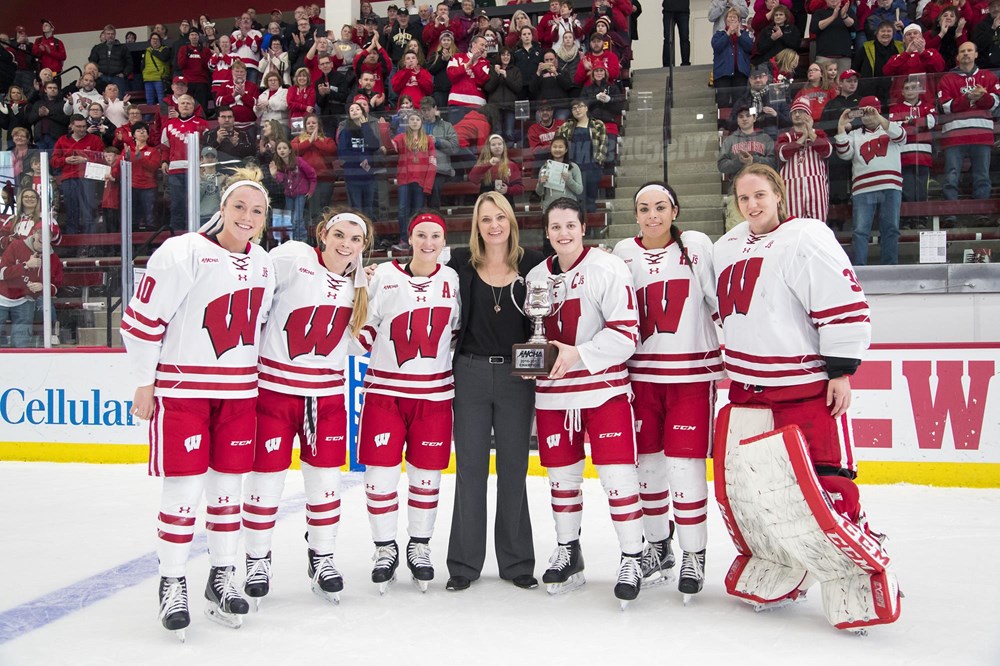 Katie Million (center)
That trend was short-lived. The Frozen Four title game in 2019 was an all-WCHA affair again. Minnesota won the regular season title that year behind Zumwinkle and Nicole Schammel’s big offensive outputs, but Wisconsin took the Final Faceoff crown with a 2-1 victory at Ridder. Two weeks later the Border Battle moved east and the Badgers rode Annie Pankowski’s clutch post-season run and Campbell’s goaltending to a 2-0 victory in the rematch at Hamden, Conn.
It was the fifth title for the Badgers and Coach Mark Johnson and started a string of three titles in five years. It was also the final event in the Katie Million era as commissioner. She resigned to become the director of women’s national team programs for USA Hockey.
But even with all the changes, the WCHA had proved again it was the dominant league in women’s college ice hockey.
Editor’s note: Bill Brophy is the former sports editor of the Wisconsin State journal who has covered the men’s and women’s WCHA since 1975. He has done radio and television for Wisconsin’s men’s hockey since 1990 through last season and has worked for the women’s WCHA as a public relations consultant since 2006.
Part 5 of the series: Battling through Covid and looking to future