Editor’s note: This is the final installment of a five-part series chronicling the history of the Western Collegiate Hockey Association, now in its 25th season as the best conference in women’s ice hockey.
By Bill Brophy
You sit down in Mark Johnson’s second floor office at LaBahn Arena in Madison, Wi. and as you chat with him about the history of the women’s Western Collegiate Hockey Association, the eye wanders to various pieces of memorabilia that symbolize Johnson’s varied and storied hockey life. One item, a picture of Mark and his dad, hockey icon Bob Johnson, is on the shelf. It stands out.
“I look at that picture of my dad and he would have loved it,” said Johnson, Wisconsin’s women’s hockey coach. “He would love the growth and the depth of the women’s game that we have created now.”
 Mark Johnson
Bob Johnson was 60-years-old when he died but his legacy in the game lives on in rinks throughout North America. It was Badger Bob, who won three men’s national titles at Wisconsin, coached the U.S. Olympic team and two National Hockey League teams, who made the phrase "It's a Great Day for Hockey" famous. You see it emblazoned in rinks across North America, including in Pittsburgh where he won a Stanley Cup and at LaBahn where his son’s team has won seven national titles and regularly draws sellout crowds.
Mark Johnson was a star in the men’s game. He won a national championship while playing for his dad at Wisconsin and an unforgettable gold medal at the 1980 Olympics. He played 11 seasons in the National Hockey League and was an assistant coach to Jeff Sauer at Wisconsin before getting introduced to the women’s WCHA in 2002. In becoming the winningest women’s coach in history with over 620 victories, he has witnessed first-hand the growth of the sport and the WCHA.
“When I started, Minnesota and Minnesota Duluth had great runs with great teams and we started to join the party.,” said Mark. “The most important things were to get a balance, teams that were starting programs and building programs and get them to point where they could compete. A weekend series between X and Y early on you could say they one team was going to sweep. Now we are at point in our league where teams are deeper and well-coached. Games are competitive. Games are fun.
“It’s no different when my dad came to Madison and he’d go to dinners and tell people to come to a game and see what you think. I would say 95 percent or higher of the people that came to a game for the first time were amazed at the skill level and talent and competitiveness. That is the point we are at now.”
In its first 24 years, the WCHA has won an unprecedented 20 national championships while finishing as the national runner-up nine times since 1999. Ohio State, the league champion in 2023-24, and Wisconsin are ranked 1-2 in polls heading into the last week of the season again. Since the inception of the NCAA women’s ice hockey championship in 2001, the WCHA has won 19 titles, including the last four (Wisconsin has won seven titles, Minnesota has won six, UMD five and Ohio State one national championship). The WCHA has had at least one team in every Frozen Four and qualified two or more teams in 17 Frozen Fours.
The league has produced nine Patty Kazmaier Memorial Award winners, which goes to the best women’s collegiate player annually, and had 24 student-athletes who were among the top-3 finalists for the award. In addition, WCHA student-athletes have been recognized as All-Americans 121 times in league history.
Brad Frost has been in the WCHA for 23 years, first as an assistant coach and then the last 17 as head coach at Minnesota. He is now fourth on the all-time winningest list of coaches (with over 490 victories).
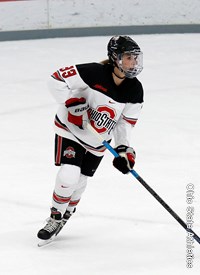 Jincy (Dunne) Roese
“You can’t argue which is the best league because the record speaks for itself,” said Frost. “The coaches are fantastic. All of them are very, very good and looked upon as the best. The players have been incredible, the best of the best. We discovered that when we tried to pick the top 25 (players in the league’s first 25 years) We had to leave off all-Americans and Olympians”.
The WCHA is having an exciting season in its 25
th year. Attendance is up. WCHA games are now available on streaming platforms and often on television. The national tournament will be streamed with the finals on television. At the youth level, more girls than ever are playing hockey and more girls are getting an opportunity to play at younger ages. At the other end of the spectrum, the Professional Women’s Hockey League started in 2024 with big crowds and big headlines.
Laura Halldorson has seen the widening improvement in the game up close. She coached three national championship teams at Minnesota in 2002, 2004 and 2005 and has always been an advocate of the sport and the WCHA.
“Having seen women’s hockey since the mid-70’s, from that point to now, it is like night and day,” said Halldorson. “In 25 years there has been great progress in many areas, but to me, it is the depth on teams. In the early days, teams had one super line but now there is more consistency throughout the lineup so it makes for a really high-level game. The speed, strength and skills of players are at a much higher level. Now players have an opportunity to train and with opportunities at the college and now pro level, it makes people want to achieve more.”
Ohio State may be the poster child for achieving more. The Buckeyes have become the new bully on the block, both in the WCHA and nationally. Under Halldorson’s former player, Nadine Muzerall, the Buckeyes have won two league championships, two Final Faceoff championships and one national title since 2020.
The decade of the 20’s began with a change at the top of the WCHA. Jennifer Flowers, an assistant commissioner for the Northern Sun Intercollegiate Conference, was named as the vice president of the WCHA and new commissioner for the women’s league. She succeeded Katie Million who left to become the executive director of USA Hockey shortly after presenting the first Julianne Bye Cup to Minnesota in 2019.
The Cup is named after long-time women’s hockey advocate Julianne Bye. It is a custom-made perpetual traveling trophy that has been presented to the winner of the regular season championship each season. The trophy travels from champion to champion at the conclusion of each regular season. The first one was presented to Minnesota in 2019. Since then, Wisconsin and Ohio State have won the Cup twice and the Gophers won it again in 2021-22.
Flowers steered the WCHA through the challenges of the Covid-19 days. In her first year on the job, Wisconsin won the regular season title in 2019-20 behind the goal-scoring of Daryl Watts and the aggressive play of Abby Roque, but Ohio State won its first-ever playoff championship.
With future Olympian Emma Maltais and All-American Jincy Dunne leading the way, Tatum Skaggs’ overtime goal gave the Buckeyes a 1-0 overtime victory over Wisconsin. But just a few days after Muzerall and her team celebrated at Ridder Arena, Flowers had to tell Muzerall that there would be no NCAA tournament that season because of the quickly-spreading Covid, the pandemic which shut down many industries in North America that year.
 Nadine Muzerall
As vaccines were developed, all of the U.S. learned to live with Covid. So did the WCHA and through teleconferencing with administrators and coaches at league schools, Flowers and the league came up with a plan to play the 2020-21 season. Schools used an abundance of caution and set up testing protocols for players and coaches so that a limited league schedule could be played without fans in the stands. Cardboard cutouts in the stands became as obvious as shots on goal that strange season, but Wisconsin went 12-3-1 to win the Covid year championship and was awarded the Julianne Bye Cup.
The Badgers won every trophy that season of Zoom calls and Covid-testing. With Watts averaging better than a point game, Wisconsin made it to the Final Faceoff championship and beat up-and-coming Ohio State 3-2 on Lacey Eden’s overtime goal. Two weeks later, Watts, the country’s leading goal-scorer, banked the puck off the goalie Aerin Frankel from behind the net to give Wisconsin a 2-1 victory over Northeastern in the NCAA title game. The eight-team tournament was held with all games played in Erie, Pa. and the Badgers emerged with their second straight tile and sixth overall.
About a month after the 2020 season ended, Flowers and league administrators voted to accept St. Thomas as an eighth league members at its annual meeting and the NCAA announced in July that summer that it would allow St. Thomas to jump from Division III to Division I. It meant that the WCHA, which had played with seven team since North Dakota suddenly folded its program at the end of 2016-17 season, would go back to eight teams beginning with the 2021-22 season. When the Tommies joined the conference, there would be no more bye weeks which will mean a fuller schedule for these teams. St. Thomas, which had never a losing women’s hockey season in 20 years of Division III play, also announced it would go Division I and were accepted into the men’s WCHA.
There was also change in the structure of the league. On June 28, 2019, seven schools from the ten-member men’s WCHA, which began in 1951 as a men’s-only league, began the process of withdrawing from the conference, with the intent of forming a new conference, the Central Collegiate Hockey Association, for the 2021–22 season. Those seven schools were Bemidji State, Bowling Green (who had retained the rights to the CCHA name), Ferris State, Lake Superior State, Michigan Tech, Minnesota State and Northern Michigan and they cited a more compact geographic footprint as one reason for the move. That meant three WCHA members (Alabama-Huntsville, Alaska and Alaska-Anchorage) were geographic outliers in the WCHA, and were absent from the change in landscape.
On February 18, 2020 these seven schools announced they would begin competing in a new CCHA in 2021–22. Later that year, in July, 2020, St. Thomas joined the CCHA as a member, bringing the membership up to an even eight teams.
So with its identity now changed to a women’s only-league, the WCHA proceeded under Flowers with eight teams. Back on the ice in 2021-22, fans returned and so did normalcy at the rink. Minnesota won the league title and Gopher forward Taylor Heise, a future Olympic star, won the Patty Kazmaier Award and was one of four WCHA players named all-Americans with Minnesota Duluth’s Gabbie Hughes, Ohio State’s Sophie Jaques and Wisconsin’s Watts. The Gophers beat Duluth 5-1 in the semifinals of the Final Faceoff and Ohio State edged Wisconsin 2-1 and made it to the title game for the third straight year. Paetyn Levis’ overtime goal gave the Buckeyes a 3-2 victory over the Gophers in the title game and, unlike two years earlier, they got to play in the NCAA tournament. The national tourney had expanded to 11 teams for the first time and four WCHA made the field. In the all-WCHA final at Penn State, Ohio State won its first-ever national championship with a 3-2 victory over Minnesota Duluth, The Buckeyes became the fourth WCHA to win a national championship.
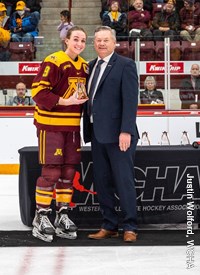 Taylor Heise (left) and Tracy Dill
There was another change at the top of the WCHA prior to the 2022-23 as Flowers resigned as commissioner to take a job as the athletics director at Southwest State in Marshall, Mn. Tracy Dill, a long-time administrator who had recently retired as the athletics director at Bemidji State, was named the interim commissioner, a position he still holds. The competitiveness and excitement didn’t change a bit. In Feb, 2023, St. Cloud State beat Wisconsin 1-0 before 14,430 fans at the Kohl Center in Madison. It was the sixth time to draw more than 10,000 at a women’s hockey game with the most (15,539) coming in 2017. TV and streaming exposure expanded thanks to Dill’s work with Big Ten Network and setting up televised games in the Twin Cities.
Ohio State, with Patty Kaz Award winner Jaques leading the way, won its’ first-ever Julianne Bye Cup, beating Wisconsin at LaBahn on the last day of the season. Showing the balance of power was divided among three excellent teams in this post-Olympic season, Minnesota won the Kwik Trip Final Faceoff title by beating Ohio State 3-1 at Ridder Arena. Then two weeks later with four of the 11-team field from the WCHA, the league got three teams in the Frozen Four in Duluth. Wisconsin beat Minnesota 3-2 in an overtime classic in the NCAA semifinals and Ohio State shutout Northeastern 3-0. Wisconsin won its seventh national title with a hard-fought 1-0 victory over Ohio State.
Johnson thought the tournament served as an advertisement for the women’s game and the WCHA.
“I think of where we were at 15, 18 years ago to now and I think where we are at now,” said Johnson. “I think of our game this past spring, the semifinals up in Duluth, I think that is one of the best games I have ever been a part of. The ebbs and flows. Both teams played well. Both goalies played well. Both teams had a chance to win. Fortunately for one team or unfortunately for the other, somebody is going to score and come away happy and the other disappointed. I am looking at it though and I am thinking ‘Wow”. I wish the game was on ABC or ESPN so people all over the country could see it. That was how far we have come. The rivalries have been built because of the magnitude of the games where we get into league championship and playoff championship or NCAA games where teams compete against each other.
“Last year was probably the strongest ever. That is credit to the players and the coaches and the programs that keep developing.”
The 25
th year of the WCHA is no different. The top two teams in the country are league champion Ohio State and defending national champion Wisconsin. Five teams have a shot at playing in the national tournament.
But the game is changing. College sports are changing. NIL money and the transfer portal mean players are more likely to change schools. There is a professional league now that will provide opportunities after graduation and international play. Coaches and administrators will need to be nimble to adjust to future inevitable change. However, the first 25 years of the WCHA provided a foundation for the sport and the women’s game only got better as the landscape changed in college athletics. Four schools won national championships and set the standard for years to come: The world of women’s college ice hockey has learned emphatically that the West is best.
Editor’s note: Bill Brophy is the former sports editor of the Wisconsin State journal who has covered the men’s and women’s WCHA since 1975. He has done radio and television for Wisconsin’s men’s hockey since 1990 through last season and has worked for the women’s WCHA as a public relations consultant since 2006.
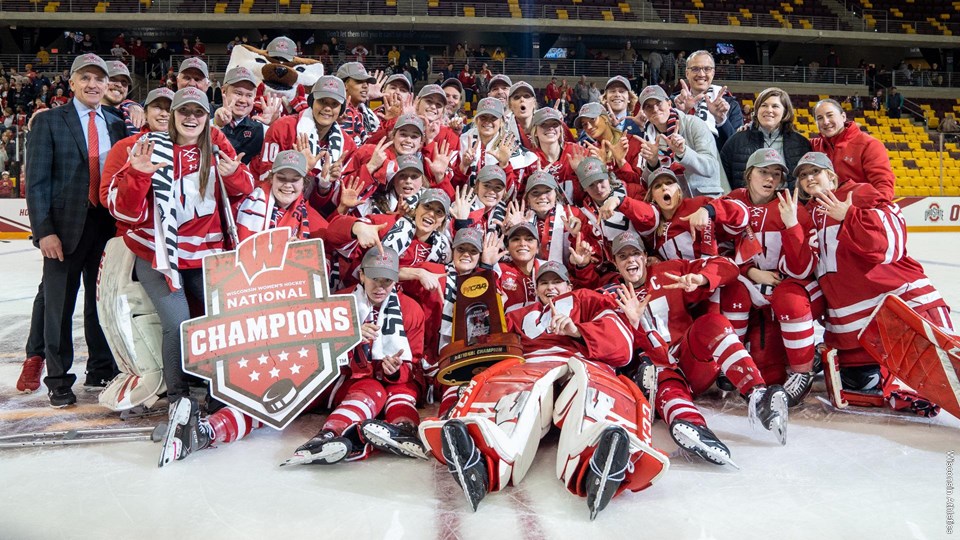 2023 NCAA Champions from Wisconsin